Day 32:Order Enums: Mapping Status Transitions at Execution Speed

What You Will Learn Today
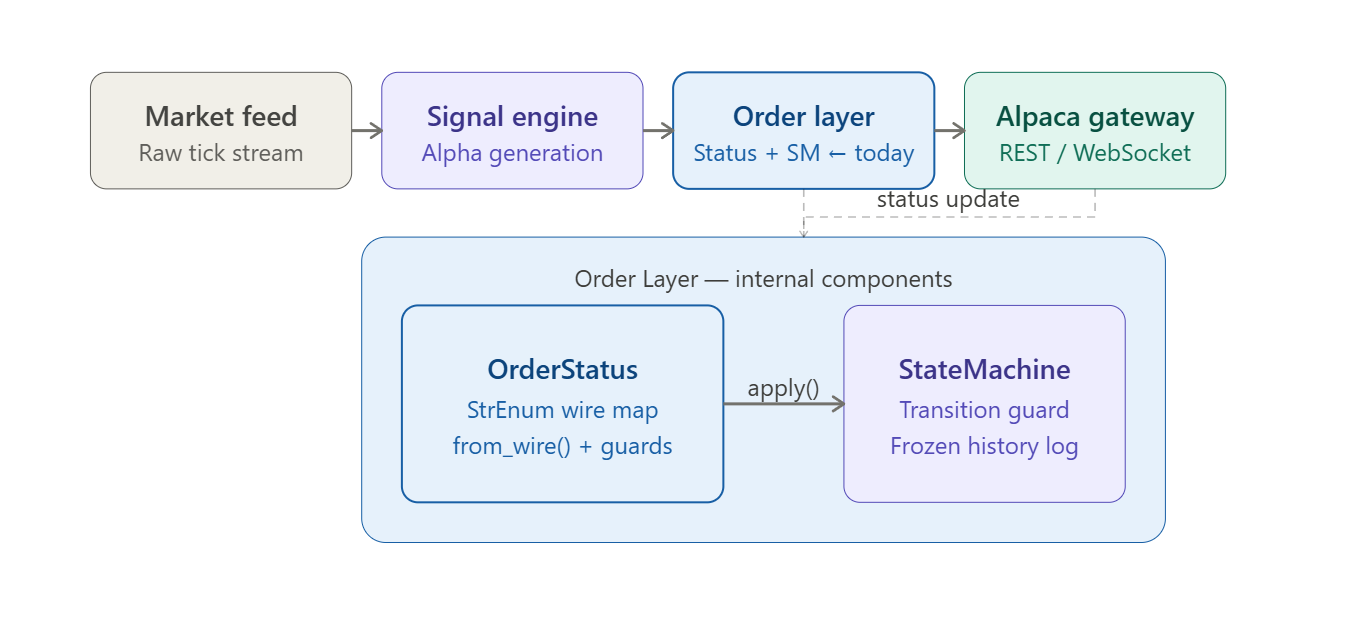
By the end of this lesson, you will understand why string comparisons on order status lead to silent P&L corruption, and you will have a working state machine that prevents it. This is the kind of code that separates engineers who have watched an order disappear from engineers who have not.
You will build three things:
OrderStatus — an enum that maps exactly to Alpaca’s wire format
Order — a frozen, immutable snapshot of every order state
OrderStateMachine — a guard that enforces valid transitions and prevents impossible state hops
Before you start: You need Python 3.11 or later, a free Alpaca Paper Trading account at alpaca.markets, and about 30 minutes. Run
python --versionnow to confirm.
The “Dictionary of Strings” Trap
When someone first wires up a live broker API, the order update handler usually looks something like this. It seems reasonable. It works in backtests.
# This code will work in your backtest.
# It will fail silently in production.

def handle_order_update(payload: dict) -> None:
    if payload["status"] == "filled":
        record_fill(payload)
    elif payload["status"] == "canceled":
        cancel_position(payload)
    elif payload["status"] == "new":
        track_pending(payload)
Four ways this breaks in production
Each of these is a real failure mode. None of them will raise an exception. They all corrupt state silently.
1. Alpaca returns "partially_filled" as a distinct status. Your record_fill never runs. The order sits in limbo. You accumulate unhedged delta that grows with every price tick.
2. You cannot add a new status without breaking the chain. "pending_new", "accepted", "pending_cancel" — all valid Alpaca statuses, all unhandled. Not handled means silently skipped.
3. No transition guard. Nothing stops an order from jumping from NEW to FILLED without logging PARTIALLY_FILLED intermediate states. On a partial fill, your P&L calculation is wrong.
4. Thread safety is zero. If two WebSocket messages for the same order arrive out of order — a common occurrence under load — the mutable dict gets overwritten. The earlier message wins or loses depending on timing alone.
The Failure Mode
The technical crash is not an exception — that would be easy to catch. The failure mode is silent state corruption.
Picture a volatility spike during an earnings announcement. Your strategy fires 12 orders in 400 milliseconds. The Alpaca WebSocket pushes updates out of sequence, which is completely normal under load. Your string-comparison handler processes
FILLEDbeforePARTIALLY_FILLEDfor order #7. The position tracker marks the order complete at 80 shares instead of 100. The remaining 20 shares stay open, untracked, working against you.By the time you notice, the position has moved 0.8% against you. On 100 orders per day that is not a rounding error — it is account ruin, compounding silently, with no log entry anywhere.
Root cause: The absence of a state machine. Without enforced transition rules, your order lifecycle is a free-for-all. An order can go from any state to any other state, in any order, and nothing complains.
The AutoQuant-Alpha Architecture
The solution has three layers. Each layer solves exactly one problem, and they are designed to compose cleanly.