Day 71 — The Pandas Loader: Reading Local Trade CSVs Without Lying to Yourself

The “Just Use read_csv()“ Trap
Every junior engineer’s first trade journal loader looks like this:
import pandas as pd
df = pd.read_csv("trades.csv")
df["pnl"] = (df["exit_price"] - df["entry_price"]) * df["qty"]
print(df["pnl"].sum())
It runs. It prints a number. It looks done. This is exactly how account-ruining bugs get shipped, because the failure isn’t a crash — it’s a quiet, confident wrong answer.
Three things are broken and none of them throw an exception:
pandasinfers dtypes column-by-column, independently, from a sample of rows. Aqtycolumn that’s100for the first 500 rows and100.5(a partial fill) on row 50,001 silently upcasts the whole column tofloat64— or worse, if a single row has a stray comma or currency symbol, the column becomesobject, and every downstream arithmetic op either throws deep in the call stack or, if you’ve cast with.astype(float)somewhere upstream, coerces garbage intoNaNand keeps going.Prices and P&L in
float64accumulate representation error.0.1 + 0.2 != 0.3isn’t a party trick — it’s what happens to every basis-point calculation you run through afloat64column over tens of thousands of rows. It won’t blow up on day one. It will blow up during a reconciliation audit six months later when your ledger is $340.17 off from the broker’s, and nobody can tell you why.read_csv()loads the entire file into memory before you’ve validated a single row. A malformed row on line 400,000 of a 2GB export doesn’t fail on line 400,000 — it fails after the entire file has already been parsed, tokenized, and materialized into a DataFrame, burning memory and I/O time you’ll never get back once you hit theParserError.
None of this is a “later” problem. It’s a day-one problem, because trade journal analytics is the foundation every later system in this course — position tracking, risk limits, execution quality monitoring — reads from. Garbage in the journal is garbage in the risk engine.
The Failure Mode, Precisely
The crash you do see is pandas.errors.ParserError: Error tokenizing data. The crash you don’t see is worse: a qty column silently downgraded to object dtype means df["qty"].sum() either raises TypeError: can't multiply sequence by non-int three functions away from the actual bug, or — if there’s any numeric-looking string in the mix — pandas will happily do string concatenation instead of addition on part of the column. Your P&L total is now wrong, unflagged, and load-bearing for every trade decision downstream.
The root cause is architectural: type inference is not type validation. Pandas’ job is to guess a reasonable dtype fast. It is explicitly not pandas’ job to tell you whether your data is correct. Treating read_csv() as a validation step is the entire trap.
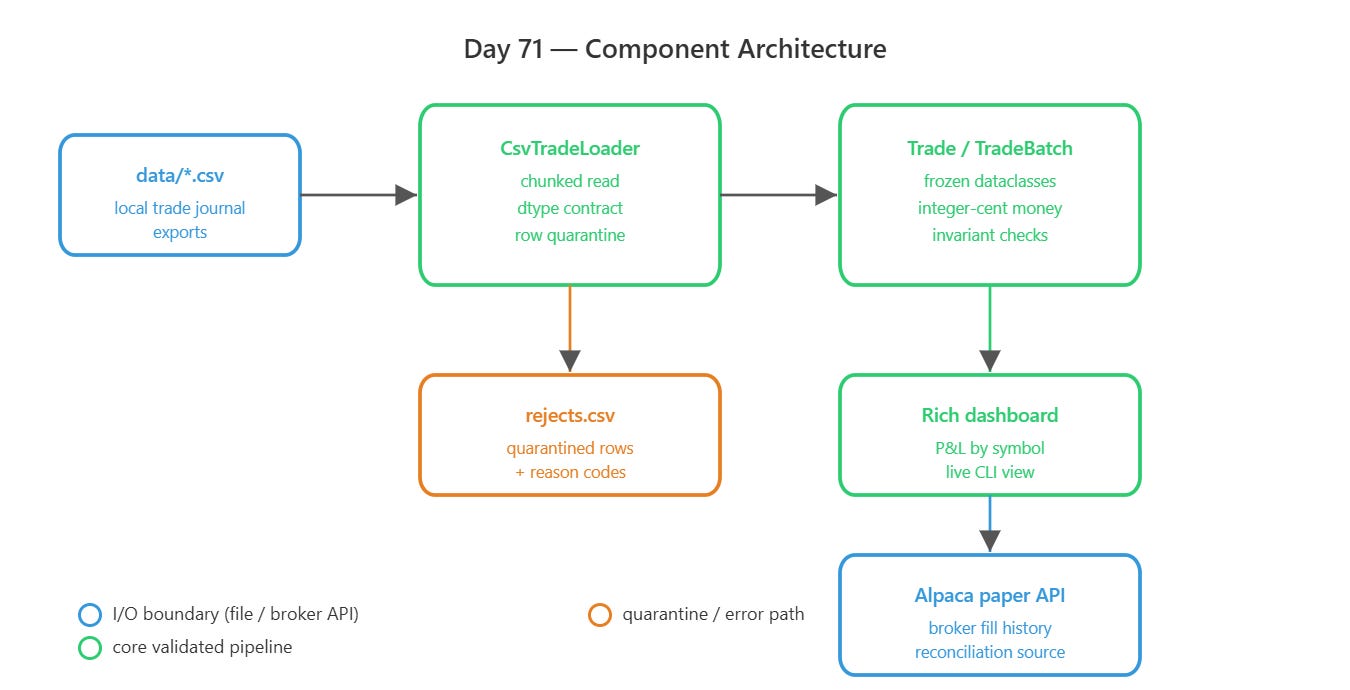
The AutoQuant-Alpha Architecture