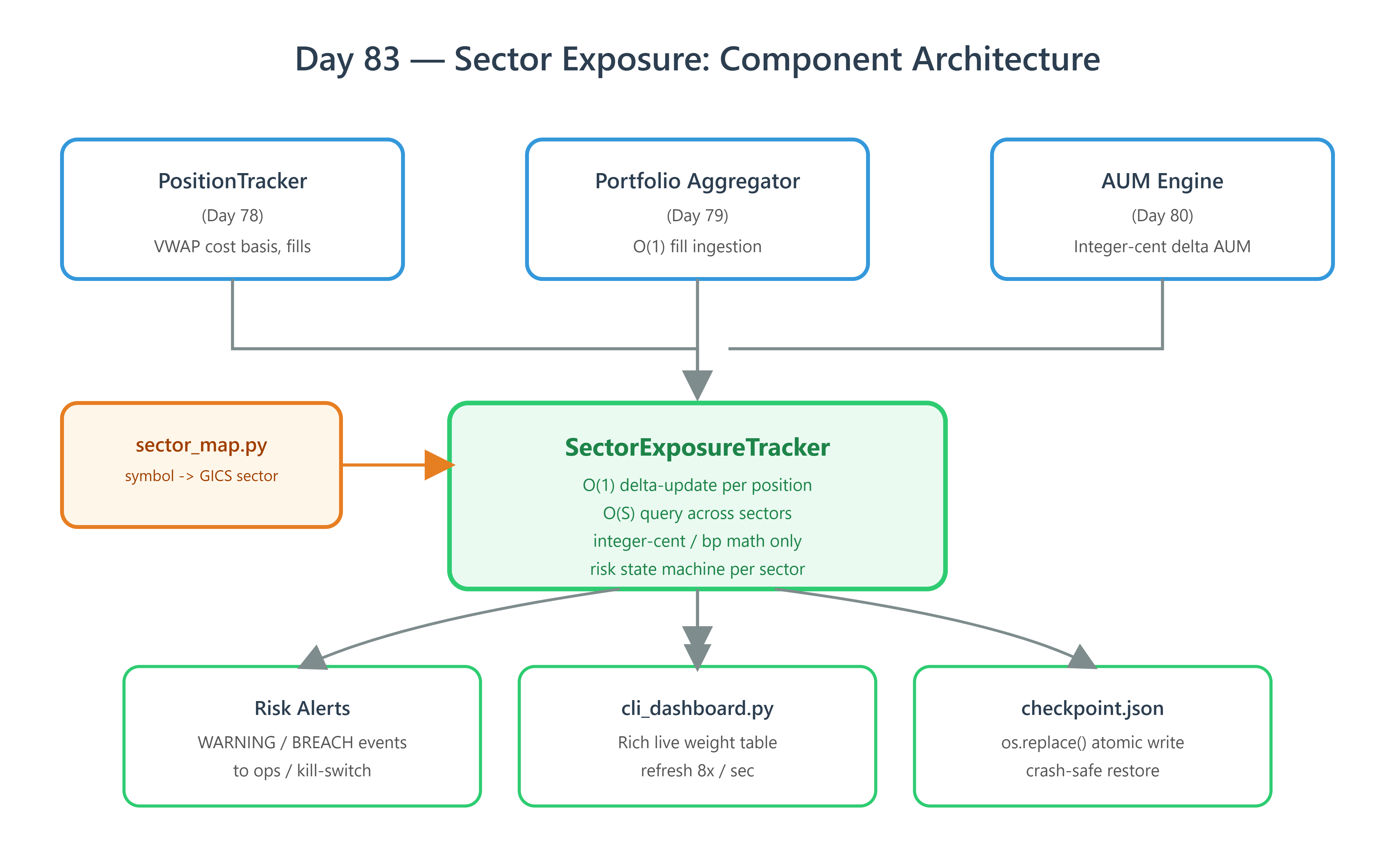
Day 83 — Exposure Logic: Sector-Weight Distribution

The “Rescan Everything” Trap
Here’s how a junior engineer builds sector exposure the first time: a get_sector_weights() function that loops over every open position, looks up its sector, sums market value into a dict, then divides each bucket by total AUM. It’s twelve lines of code, it’s obviously correct, and it ships.
It also ships a landmine.
That function gets called from two places in a live system: the risk dashboard, which polls it every second, and the pre-trade check, which calls it before every single order to make sure the fill won’t push a sector over its concentration limit. Neither of those call sites cares that the function is O(N) in the number of open positions — until the portfolio grows past a few hundred names and a volatility event hits. Now you’ve got a burst of fills arriving faster than your risk check can rescan the book, the pre-trade check starts queueing behind itself, and your order placement latency — the thing that was supposed to protect you during the spike — degrades exactly when protection matters most. You don’t find out about this in backtesting, because backtests don’t model queueing under load. You find out in production, on the one day a sector actually moves 4% in an hour.
The Failure Mode, Precisely
The bug isn’t the loop itself — a modern CPU can sum a few hundred floats in microseconds. The bug is calling frequency times work per call. A full rescan is fine at 1 Hz on a 50-position book. It is not fine at tick frequency on a 500-position book during a volatility spike, because tick frequency and position count both go up at exactly the moment you need the answer to be right. This is the same class of failure the course has hammered since Week 11’s DrawdownTracker: state that’s cheap to derive from scratch at rest becomes expensive to derive from scratch under load, and load is precisely when correctness matters most.
There’s a second, quieter failure mode: float accumulation. Sum a few hundred market_value floats every tick for an hour and your sector totals drift from the true AUM-weighted values by an amount that’s small individually but shows up as a phantom few basis points of “exposure” that doesn’t reconcile against your ledger. On a system that gates trades on a 25% concentration limit, a 3 bp phantom is a bug you’ll spend a day chasing at 2 a.m.
The AutoQuant-Alpha Architecture