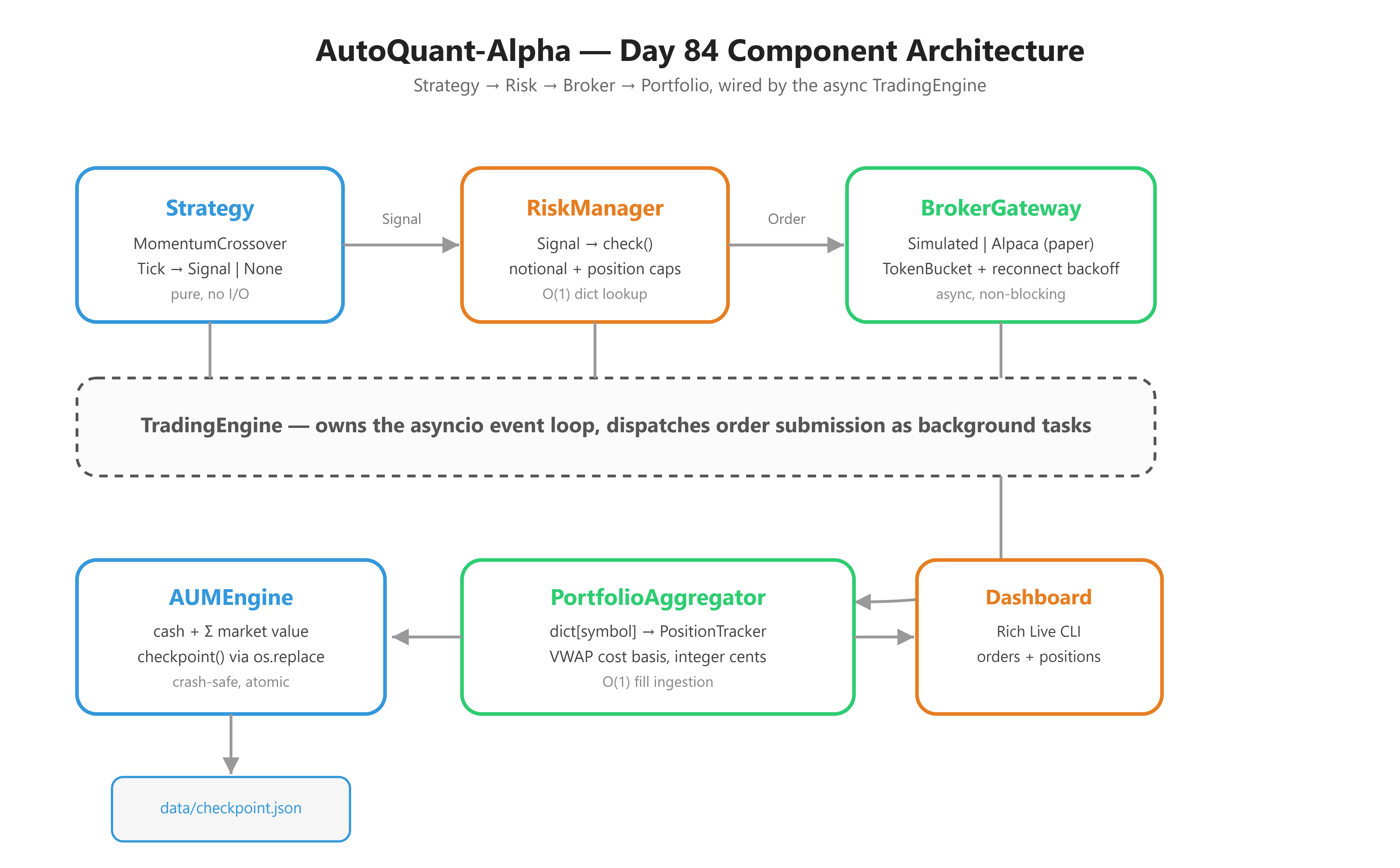
Day 84 — The Wiring Diagram Nobody Draws Until It’s Too Late

You’ve spent three days building the pieces. Day 78 gave you an O(1) position tracker. Day 79 gave you a portfolio aggregator that doesn’t replay the world on every fill. Day 80 gave you an AUM engine with crash-safe checkpoints. Today isn’t a new module — it’s the thing that turns three well-tested components into a system that doesn’t fall over the first time a broker connection blips mid-fill.
The “Just Call It Inline” Trap
Here’s how a junior engineer wires a strategy to a broker:
def on_tick(tick):
    signal = strategy.on_tick(tick)
    if signal:
        order = build_order(signal)
        response = broker.submit_order_sync(order)  # blocking HTTP call
        portfolio.apply_fill(response.fill)
It works in a demo. It works in backtests where “the broker” is a dictionary lookup that returns instantly. It ships. Then, three weeks into paper trading, a volatility spike hits, Alpaca’s API queue backs up, and submit_order_sync takes 400ms instead of 15ms. Every tick behind it queues. By the time the response comes back, the market has moved 40bps and the fill price you’re about to book bears no relationship to the signal that triggered it. Worse: if the process dies between “order submitted” and “fill recorded,” you now have an order sitting live at the broker that your own book doesn’t know about. You will discover this the hard way, at the worst possible time, reconciling against a broker statement that disagrees with your PnL by an amount that ruins your day.
The bug isn’t in any one module. Position tracking is correct. The broker call is correct. The failure mode lives entirely in the wiring — the assumption that submitting an order is a cheap, synchronous, always-succeeds operation that can block the tick loop without consequence.
The Failure Mode, Precisely
Three things go wrong simultaneously when you couple tick ingestion to broker I/O:
Head-of-line blocking. A single slow or hanging
submit_ordercall stalls every subsequent tick, which stalls every subsequent signal, which means your strategy is now trading on stale information exactly when volatility (and therefore the value of fresh information) is highest.Unbounded reconnect storms. A naive WebSocket client that retries immediately on disconnect will, under any real outage, either get itself rate-limited or DOS the broker’s auth endpoint at the worst possible moment — right as the market is moving and you most need the connection back.
No state machine, so no way to know what’s actually true. Without an explicit
Orderlifecycle, a duplicate “accepted” message after a “filled” message either gets silently dropped (fine) or silently re-processed (very much not fine — you now think you’re flat when you’re not).
None of these are exotic. They’re the default behavior of “call the broker function when you get a signal.”
The AutoQuant-Alpha Architecture